If your factory radio supports 4-ohm speakers and your car has room behind the grille, start with the Kicker 46CSC6934 pair. The Skar RPX69 is another 4-ohm option and worth checking if you need a different basket fit. Choose the JBL Club 964M only if the radio or existing factory amplifier is documented to accept a 3-ohm load. These are full-range coaxial speakers. They can restore weak or missing midbass from tired factory drivers, but they don’t replace a subwoofer for the lowest notes.
As an Amazon Associate, Diecast Audio earns from qualifying purchases. We checked the manufacturer specifications and exact Amazon US offers on November 15, 2026. These are fit and compatibility recommendations based on published specifications. Availability can change.
Compare the picks
Swipe to compare on smaller screens.
| Speaker pair | Nominal impedance | Published sensitivity | Best fit |
|---|---|---|---|
| Kicker CS 46CSC6934 | 4 ohms | 92 dB at 1 W, 1 m | 4-ohm full-range upgrade |
| JBL Club 964M | 3 ohms | 93 dB at 2.83 V | Documented 3-ohm compatibility |
| Skar Audio RPX69 | 4 ohms | 89 dB at 2.83 V | Alternative 4-ohm fit |
Check the factory system before ordering
“Without an amp” here means without adding an aftermarket amplifier. Your head unit or the amplifier already fitted to the car still drives the speakers. Check the original speaker impedance and where the replacement will be connected. A factory premium system may use a separate amplifier, lower-impedance drivers and crossover channels that send only part of the music to each speaker. A coaxial connected to a factory woofer channel may still get a low-passed signal, which means its tweeters won’t receive the full range.
Check how the original speaker mounts. A factory 6×9 opening may use its own bracket and plug. Match the available depth behind the metal and the height under the door card or rear deck grille. For a door speaker, confirm the magnet, cable and adapter clear the window throughout its travel. For a rear deck, check trunk-side access and anything that can contact the basket. The opening on the spec sheet tells you which speaker family to shop in. A model-specific fit check tells you whether the particular pair will install.
Three full-range pairs worth comparing
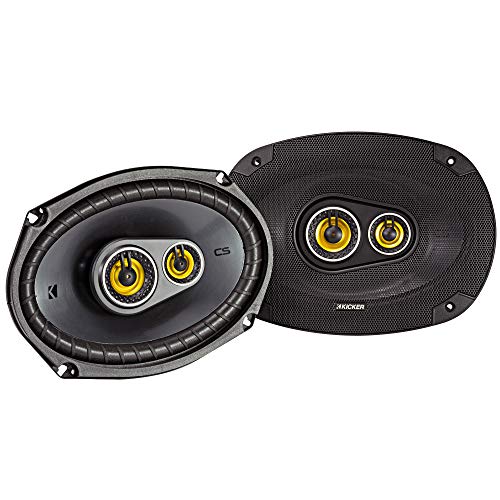
Kicker CS 46CSC6934
Check Kicker CS 46CSC6934 on Amazon · Manufacturer specifications
Kicker lists the CSC693 at 4 ohms and rates it at 92 dB measured at 1 W and 1 m. This is the option to check first if your radio needs 4 ohms and your original positions get a full-range signal. The exact listing is one pair under part number 46CSC6934. A similar title can refer to two pairs or a bundle with smaller door speakers.
Kicker rates the pair’s model at 150 W RMS per speaker. That figure describes power handling and does not mean a stock head unit needs to supply 150 watts. The factory radio’s actual output and the mounting seal will matter more to the result. Kicker’s published drawing distinguishes how far the parts protrude above the mounting surface and how much clearance you need below it. Check the lower basket and the grille separately, especially if you’re using a spacer.
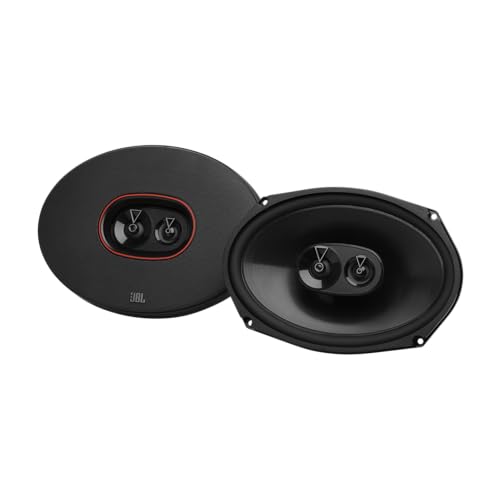
JBL Club 964M
Check JBL Club 964M on Amazon · Manufacturer specifications
JBL’s Club 964M uses a 3-ohm nominal load, a polypropylene woofer and a silk dome tweeter. JBL lists 85 W RMS handling and a sensitivity of 93 dB at 2.83 V. Treat it as a candidate for compatible factory systems. If the radio’s instructions specify a minimum of 4 ohms, pick a 4-ohm model instead. A nominally lower impedance can draw more current, and it’s the head unit or factory amplifier that has to handle it.
This exact model is the 964M, not the older Club 9632 or a 6×8 Club model. Check the supplied brackets and vehicle adapter before ordering. If you need a harness or mounting spacer, include it in the installation budget and confirm that the resulting clearance still works.
Skar Audio RPX69

Check Skar Audio RPX69 on Amazon · Manufacturer specifications
The RPX69 is a 4-ohm three-way coaxial pair. Skar lists 89 dB at 2.83 V and specifically identifies factory radio power as a supported use. It is a straightforward alternative if the basket or local offer suits your installation. The sensitivity numbers in the comparison use two different references. The Skar number can’t be compared directly with Kicker’s 1 W rating as if they were recorded on the same setup.
Choose the Skar over the Kicker if your vehicle fit check favors it or the complete installed set makes more sense. Before buying, check the rear mounting clearance, basket shape, terminal position and any adapters. Matching the 6×9 label doesn’t resolve differences in the hardware. If you have a separate factory tweeter and woofer, also read the guide to replacing components with coaxials.
Why bass can disappear after a speaker swap
Sensitivity numbers need a reference
Sensitivity describes output under stated test conditions. Some makers specify 1 watt at 1 meter. Others use 2.83 volts, which corresponds to 1 watt into an ideal 8-ohm load but about 2 watts into a 4-ohm load and about 2.7 watts into a 3-ohm load. Real speakers vary in impedance with frequency. Comparing the numbers without the reference can make a low-impedance model look more efficient than it is. Use sensitivity to narrow choices once fit and compatibility are settled.
Also treat minimum frequency ratings as context. A quoted low endpoint is difficult to compare when makers use different tolerances or don’t give one. It doesn’t tell you how much usable output you’ll hear with the speaker mounted in a car door, on a factory radio, with the factory EQ still applied. A secure fit and a sound gasket are more useful starting points than a low number on a chart.
Seal the mount and check polarity
Use the right vehicle adapter and a gasket so air doesn’t leak through a gap around the speaker frame. The front and rear of the cone move air in opposite directions, and a poor seal lets those waves partially cancel. Avoid blocking door drains or interfering with the window mechanism. Secure the wires away from moving parts. If you’re working near side airbags or sensitive connectors, use the vehicle service procedure or an installer.
Check polarity on both speakers against the wiring diagram or a verified harness. If one speaker is reversed relative to the other, bass can sound weaker when both sides play together. Use the fader and balance controls to isolate each channel before putting all the trim back. Compare a familiar track at moderate volume and listen for rattles or buzzing. If bass sounds better on one side alone, check wiring and mounting before turning the bass control up.
Keep the source in its useful range
A factory radio may reduce bass at higher volume or shape the signal for the original speaker. If a replacement sounds thin only when you turn up the volume, try a quieter setting and compare the same source. Large EQ boosts can run the radio out of clean headroom faster. If the existing system filters bass out of the replacement channel, a different coaxial won’t restore what the signal doesn’t contain. Check the wiring and crossover scheme first.
If your goal is the deepest notes in hip-hop or electronic music, decide that before ordering another pair. A compact powered subwoofer includes its own amplifier and requires power and a suitable signal feed. It’s a different upgrade from replacing factory speakers, and it can be a better use of the budget if the missing octave is the reason you started shopping.
FAQs
Will 6×9 speakers improve bass on my factory radio?
They can improve midbass if the factory speakers are worn, poorly sealed or otherwise deficient. The result still depends on the system’s filtering, available power and mounting. If the system already has an aggressive high-pass filter, expect less change from the speaker alone.
Can I replace a 4-ohm speaker with a 3-ohm JBL?
Use the JBL only if the radio or amplifier supports that load. The removed speaker’s label is a good starting point, but verify the minimum impedance in the documentation for the channel you are actually using. If you cannot verify 3-ohm support, stick with a compatible 4-ohm choice where the system calls for 4 ohms.
Does a three-way speaker have better bass than a two-way?
The number of ways describes which drivers cover different frequency bands. It doesn’t determine low-frequency extension or bass output. Compare fit, sensitivity test conditions and the signal reaching the woofer before choosing by driver count.
Do I need a wiring harness or adapter rings?
Often you do. A vehicle-specific harness can retain the factory connector and correct polarity, and a mounting ring can adapt the bolt pattern. A spacer changes window and grille clearance in opposite directions, so measure both sides. Confirm the car’s year, trim and audio package when choosing accessories.
Why does one speaker sound fuller than the pair?
Check polarity first. A reversal can cause partial cancellation when both play the same bass frequencies. If wiring is correct, check balance, front-to-rear signal differences and air leaks at the mounting surfaces.
Will a 6×9 fit a 6×8 or 5×7 opening?
Do not assume it will. The cutout and bolt pattern can differ, and the basket or grille can interfere with vehicle parts. See our car speaker size and fit guide for the difference between a nominal size and usable mounting space.