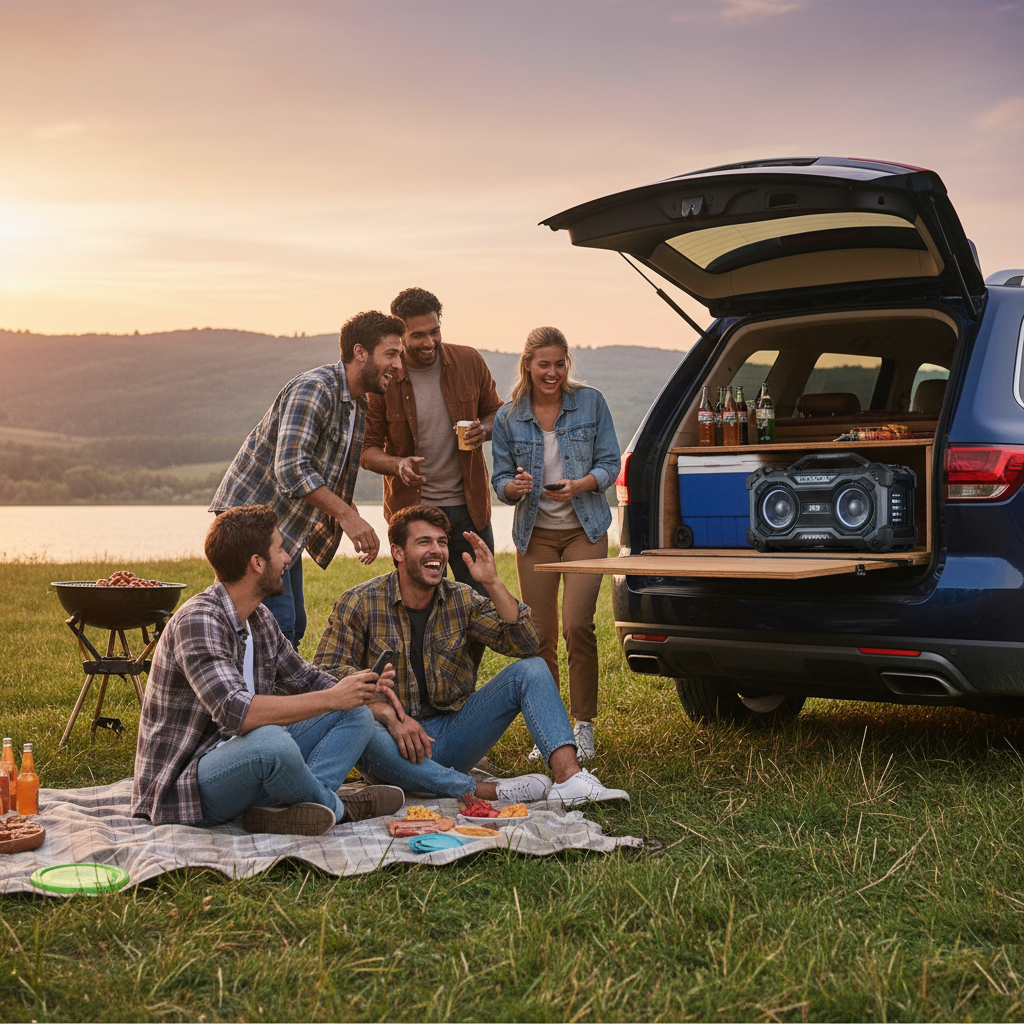
If you’ve ever stood in a parking lot before a big game, surrounded by grills, folding chairs, and music pumping from every direction, you already understand the spirit of tailgating. But when someone mentions a “tailgating speaker,” they’re referring to something more specific than just any portable Bluetooth speaker you toss in your bag.
A tailgating speaker is a category of portable audio gear designed specifically for outdoor social gatherings, particularly the kind that happen in open spaces like stadium parking lots, campsites, beaches, or backyards. These speakers are built to handle the demands of that environment: loud volume, rugged construction, long battery life, and features that make group use easy and enjoyable.
Understanding what separates a true tailgating speaker from a standard portable speaker can save you from buying the wrong thing and ending up with a device that sounds thin outdoors or dies halfway through the third quarter.
Key Takeaways
- A tailgating speaker is a portable speaker designed for loud, outdoor group use in environments like parking lots, parks, and campsites
- Volume and sound projection matter more outdoors than indoors because open air absorbs sound quickly
- Battery life should be at least 10 to 12 hours for a full day of use
- Rugged build quality, including water and dust resistance, is essential for outdoor reliability
- Connectivity features like Bluetooth range, aux input, and USB charging ports add real-world value
- Some tailgating speakers include built-in light shows, microphone inputs, or DJ effects, which may or may not matter depending on your use case
- Size and portability are a tradeoff: bigger speakers sound better but are harder to transport
- You don’t need to spend a fortune, but budget models often sacrifice volume, bass, or durability
What Actually Makes a Speaker a “Tailgating Speaker”?
The term isn’t an official product category with strict definitions. Manufacturers use it loosely, and you’ll see it applied to everything from modest Bluetooth speakers to massive rolling party systems. That said, most speakers marketed for tailgating share a few core characteristics.
Designed for Outdoor Volume
The single biggest difference between indoor and outdoor audio is how quickly sound dissipates. Indoors, sound bounces off walls and ceilings, reinforcing itself. Outdoors, it just keeps traveling outward with nothing to reflect it back. This means a speaker that sounds impressively loud in your living room might feel underwhelming in a parking lot.
Tailgating speakers are typically rated for higher output, measured in watts, and often use larger drivers or passive radiators to push more air. This translates to volume that can fill an open area without distorting at high levels.
Built to Handle the Outdoors
Tailgating environments are unpredictable. Drinks get spilled, speakers get knocked over, and weather doesn’t always cooperate. Most dedicated tailgating speakers carry an IPX rating, which indicates resistance to water and sometimes dust. An IPX5 rating means the speaker can handle splashing water from any direction, while IPX7 means it can survive brief submersion.
Beyond water resistance, look for reinforced corners, rubberized housing, and solid grille protection. These physical details matter when a speaker is being loaded in and out of truck beds and set up on uneven surfaces.
Long Battery Life
A tailgating session can run six to eight hours or longer when you factor in the pre-game and post-game. A speaker with only six hours of battery life at moderate volume is a liability. Most tailgating-focused models advertise 12 to 20 hours of playtime, though real-world performance at higher volumes is always shorter than the spec sheet suggests.
Some larger models solve this problem differently by including a DC power input so you can plug into a portable power station or your vehicle’s power outlet, giving you effectively unlimited runtime.
Key Features to Look For
Not every feature matters equally. Here’s a breakdown of what’s genuinely useful versus what’s mostly marketing.
Features That Actually Matter
- Bluetooth range: A range of at least 30 feet lets you control music from a distance without constantly walking back to the speaker
- Battery life: Look for 12 or more hours at moderate volume
- Water resistance: IPX5 or higher is the minimum worth considering
- Aux input: Useful when Bluetooth isn’t cooperating or when connecting a DJ mixer
- USB charging port: Lets the speaker double as a power bank for phones, which is genuinely useful at long events
- Carry handle or wheels: Larger speakers with wheels are much easier to transport across parking lots
Features That Are Nice But Optional
- Built-in LED light shows
- Microphone or guitar inputs for live performance
- Multi-speaker pairing (linking two units together for stereo or amplified mono)
- Built-in FM radio
- App control for EQ adjustments
If you’re hosting a large group and want a more immersive experience, the extras like lighting and mic input can add real entertainment value. For most casual tailgaters, they’re secondary to sound quality and reliability. If you’re curious about what makes outdoor speakers worth the investment more broadly, the Complete Guide to Outdoor Alexa Speakers covers related ground on outdoor audio considerations.
Tailgating Speaker Size and Portability Tradeoffs
One of the most important decisions is how large a speaker you actually need. This comes down to crowd size, how far you’re willing to carry it, and whether you have a vehicle to transport it.
| Speaker Size | Best For | Typical Battery Life | Portability |
|---|---|---|---|
| Compact (under 5 lbs) | Small groups of 2 to 4 people | 10 to 15 hours | Fits in a backpack |
| Mid-size (5 to 15 lbs) | Groups of 5 to 15 people | 12 to 20 hours | Carry handle required |
| Large (15+ lbs) | Large crowds, open spaces | 10 to 18 hours or DC powered | Wheels or two people |
Compact speakers like the JBL Flip series are genuinely portable but won’t fill a large parking lot. If you want to understand how the Flip line compares internally, the breakdown of JBL Flip 4 vs Flip 5 vs Flip 6 is a useful reference. Mid-size speakers hit a sweet spot for most tailgating groups, offering meaningful volume without requiring a hand truck to move them.
Understanding Sound Quality in Open Air
Volume alone doesn’t equal good sound. Outdoor listening also benefits from speakers with strong bass response, since low frequencies are the first to feel weak in open-air settings. Look for speakers with passive radiators or dedicated subwoofer drivers if deep bass matters to you.
What does “airy sound” mean in a Bluetooth speaker? is a concept worth understanding here. Outdoor speakers often benefit from a wider soundstage and more pronounced high-frequency presence to compensate for the lack of room acoustics. A speaker that sounds warm and full indoors can sound muddy or recessed outside.
Tailgating Speaker Comparison: What to Expect at Different Price Points
| Price Range | What You Get | What You Give Up |
|---|---|---|
| Under $50 | Basic Bluetooth, modest volume, limited bass | Durability, battery life, weather resistance |
| $50 to $150 | Solid IPX rating, decent bass, 12+ hour battery | Premium sound quality, advanced features |
| $150 to $300 | Strong output, good build quality, useful extras | Minor compared to higher tiers |
| $300 and above | High output, premium drivers, full feature sets | Portability sometimes suffers at this size |
For most tailgaters, the $100 to $200 range offers the best balance of performance and practicality. Spending more gets you better sound and durability, but diminishing returns set in quickly beyond $300 unless you’re outfitting a very large space.
Common Mistakes When Choosing a Tailgating Speaker
- Prioritizing looks over output – A speaker that looks impressive on a shelf may not project well in an open lot
- Ignoring battery life specs – Always look for real-world reviews, not just manufacturer claims
- Buying too small for the crowd – Underestimating how much volume you need outdoors is one of the most common mistakes
- Overlooking connectivity – If you plan to connect a phone, tablet, and laptop at different points, multiple input options matter
- Forgetting about charging – A USB-C charging port charges faster than older micro-USB designs
Conclusion
A tailgating speaker isn’t just a portable Bluetooth speaker with a different label. It represents a specific set of priorities: outdoor volume, rugged construction, long battery life, and practical connectivity. Whether you’re hosting twenty people in a stadium parking lot or a small group at a campsite, matching the speaker to the environment and crowd size makes a real difference in the experience.
The best approach is to start with your actual use case. How many people? How large is the space? How long will you be out there? Answer those questions honestly, and the right speaker becomes much easier to identify.
Frequently Asked Questions
What’s the difference between a tailgating speaker and a regular Bluetooth speaker?
Tailgating speakers are designed for louder output, longer battery life, and more rugged construction than standard portable Bluetooth speakers. They’re optimized for open-air environments where sound dissipates quickly and conditions are unpredictable.
How many watts do I need for a tailgating speaker?
For small groups in open spaces, 20 to 40 watts RMS is a reasonable starting point. For larger crowds or very open areas, 60 watts or more will give you the headroom you need without pushing the speaker to its limits constantly.
Can I use a tailgating speaker indoors?
Absolutely. A speaker built for outdoor use will work perfectly indoors. You may find the volume goes further than you need, but that’s rarely a problem.
How important is an IPX rating for a tailgating speaker?
Very important. Spills, rain, and humidity are common in outdoor settings. An IPX5 rating at minimum protects against splashing water, which covers most real-world scenarios.
Do tailgating speakers work well for music genres with heavy bass?
It depends on the specific model. Larger tailgating speakers with passive radiators or dedicated woofers handle bass-heavy music well outdoors. Compact models often struggle to reproduce deep bass in open air, so checking reviews specifically for outdoor bass performance is worth doing before buying.