If you’ve ever shopped for in-ear audio gear, you’ve probably noticed the terms “earbuds” and “in-ear monitors” used interchangeably. They look similar, they both sit near your ears, and they both play sound. But they are fundamentally different products built for different purposes, and understanding that distinction can save you from buying the wrong thing entirely.
This guide breaks down what separates earbuds from in-ear monitors (IEMs), who each one is designed for, and how to decide which type actually fits your needs.
Key Takeaways
- Earbuds rest in the outer ear; IEMs insert into the ear canal for a sealed fit
- IEMs offer significantly better passive noise isolation than earbuds
- In-ear monitors were originally designed for professional stage use by musicians
- IEMs typically deliver more accurate, detailed sound across the full frequency range
- Earbuds are generally more comfortable for casual, extended wear
- Driver configuration complex in IEMs, often using multiple balanced armature or dynamic drivers
- Earbuds prioritize convenience; IEMs prioritize acoustic performance
- Price ranges overlap, but high-end IEMs can reach audiophile-grade territory
What Are Earbuds?
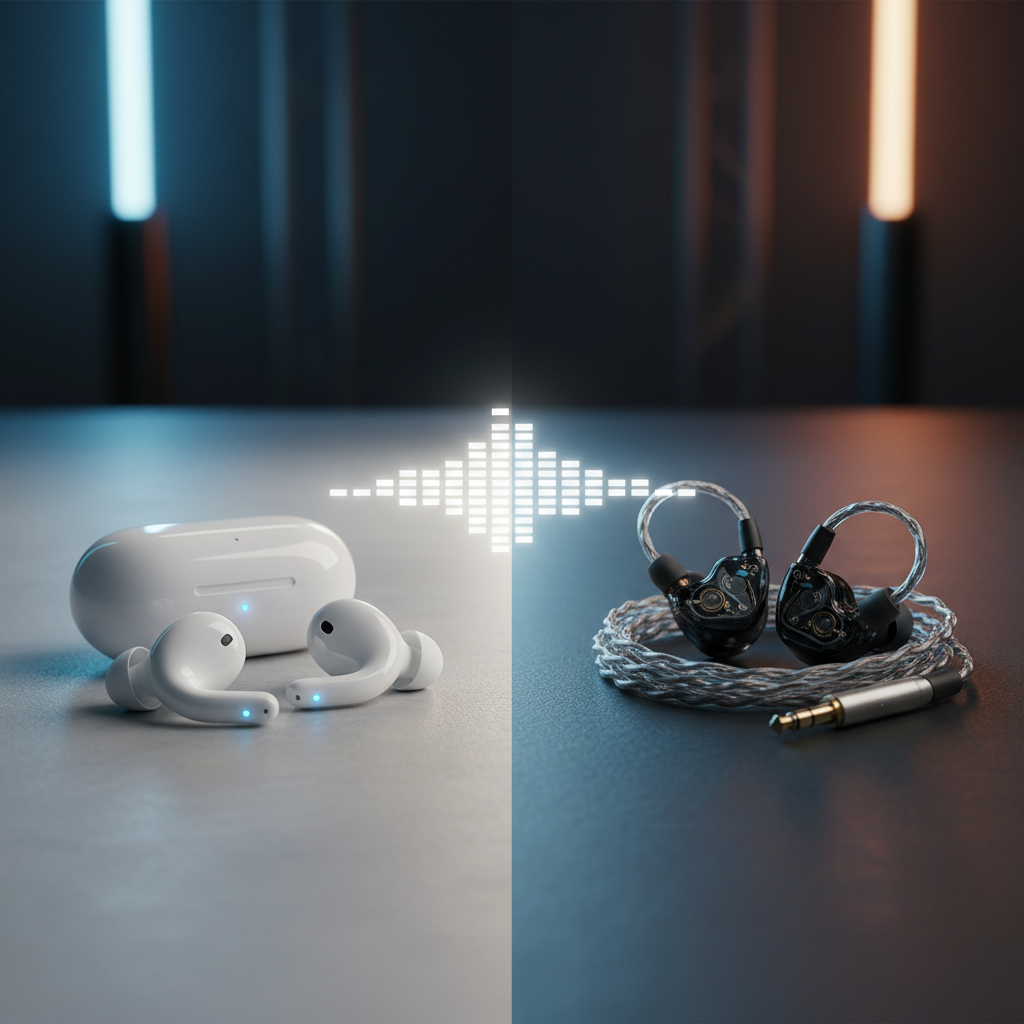
Earbuds are the small, round audio devices that sit in the outer ear, resting against the concha bowl without actually entering the ear canal. The classic Apple EarPods are probably the most recognizable example of this design. They’re lightweight, easy to put in and take out, and require no fitting or tip selection.
Because they don’t seal the ear canal, earbuds allow ambient sound to pass through freely. This makes them a popular choice for people who need situational awareness, like runners on a busy street or office workers who still want to hear their surroundings. The tradeoff is that they leak sound in both directions. You hear the outside world, and the people next to you might hear your music.
Sound Quality in Earbuds
Earbuds are generally tuned for broad consumer appeal. That means boosted bass, emphasized highs, and a v-shaped sound signature that sounds exciting on first listen. They’re not designed for critical listening or studio monitoring. The open fit also means bass response is limited since low frequencies need an acoustic seal to reproduce effectively.
That said, modern earbuds have improved considerably. Wireless earbuds with active noise cancellation have closed some of the gap, though they still don’t match the passive isolation of a well-fitted IEM.
What Are In-Ear Monitors?
In-ear monitors insert directly into the ear canal, using silicone or foam ear tips to create an acoustic seal. That seal is the defining feature of the IEM design. It blocks outside noise passively, without any electronics involved, and it creates the closed acoustic environment needed for accurate bass reproduction and detailed sound.
IEMs were originally developed for professional musicians performing on stage. Before IEMs existed, performers relied on floor wedge monitors to hear themselves over the noise of a live show. The problem was inconsistency and volume. IEMs solved this by delivering a personalized, isolated mix directly to each performer’s ears at safe listening levels.
Today, IEMs are used far beyond the stage. Audiophiles, studio engineers, and serious music listeners have adopted them for their acoustic performance and portability.
Driver Technology in IEMs
One of the biggest technical differences between earbuds and IEMs is what’s happening inside the housing. Earbuds typically use a single dynamic driver. IEMs can use dynamic drivers, balanced armature drivers, planar magnetic drivers, or combinations of all three in what’s called a hybrid configuration.
Balanced armature drivers, in particular, are compact and efficient, making them ideal for IEM designs. High-end IEMs can pack four, six, or even more drivers into a single housing, each covering a specific frequency range. A dedicated tweeter handles highs, a mid driver handles vocals and instruments, and a woofer handles bass. This kind of driver separation allows for exceptional clarity and detail retrieval that a single dynamic driver simply can’t match.
If you’re curious about how dedicated high-frequency drivers work in audio equipment, understanding what tweeters do provides useful context for how frequency-specific driver design affects overall sound quality.
Earbuds vs. IEMs: A Direct Comparison
| Feature | Earbuds | In-Ear Monitors |
|---|---|---|
| Fit Type | Outer ear, no seal | Ear canal insertion, sealed |
| Noise Isolation | Minimal (passive) | High (passive seal) |
| Sound Accuracy | Consumer-tuned | Reference or audiophile-tuned |
| Driver Configuration | Usually single dynamic | Dynamic, BA, planar, or hybrid |
| Bass Response | Limited by open fit | Strong due to acoustic seal |
| Comfort (Long Wear) | Generally comfortable | Depends on fit and tip choice |
| Typical Use Case | Casual listening, commuting | Studio, stage, critical listening |
| Price Range | $10 to $200+ | $30 to $2000+ |
Fit and Comfort: A Closer Look
Comfort is where things get personal. Earbuds win on simplicity. You put them in, they sit in your ear, and there’s no fussing with tip sizes or insertion depth. For people who find ear canal insertion uncomfortable, earbuds are the obvious choice.
IEMs require more attention to fit. You’ll typically get a selection of ear tip sizes, and finding the right one matters both for comfort and acoustic performance. A poor seal doesn’t just feel uncomfortable, it also ruins the bass response and noise isolation that make IEMs worthwhile in the first place. Foam tips generally provide a better seal than silicone but compress over time and need replacing.
Some listeners find that IEMs cause ear fatigue during extended sessions, especially if the fit is too tight or the tuning is overly bright. Others find the seal so comfortable that they prefer IEMs for long flights or study sessions precisely because of the isolation.
Noise Isolation vs. Noise Cancellation
It’s worth distinguishing between passive noise isolation and active noise cancellation, because these terms often get confused when comparing earbuds and IEMs.
Passive noise isolation is what IEMs provide by default. The physical seal of the ear tip blocks outside sound mechanically, no electronics required. This is highly effective for consistent background noise like airplane hum or office chatter.
Active noise cancellation (ANC) uses microphones and processing to generate an inverse sound wave that cancels incoming noise. Many modern wireless earbuds include ANC, which helps close the isolation gap with IEMs. However, ANC adds cost, battery drain, and can sometimes introduce a slight pressure sensation.
High-quality IEMs with good ear tips can match or exceed the isolation of many ANC earbuds without any of those tradeoffs.
Who Should Use Earbuds?
Earbuds are the right choice if:
- You want a quick, effortless listening experience
- Situational awareness matters (running, cycling, commuting)
- You find ear canal insertion uncomfortable
- You primarily listen casually rather than critically
- You want something easy to share or lend to others
- Budget is a primary concern and you don’t need audiophile-level performance
Who Should Use In-Ear Monitors?
IEMs are the better choice if:
- You’re a musician, audio engineer, or serious audiophile
- You want the most accurate sound reproduction possible from an in-ear format
- You need strong passive noise isolation without relying on electronics
- You’re building a dedicated listening setup and want to pair IEMs with a quality source
- You want detailed sound for genres like classical, jazz, or acoustic music where imaging and separation matter
- You’re willing to spend time finding the right ear tip fit
For listeners who want to take IEM performance even further, pairing them with a dedicated source component makes a real difference. Our guide on choosing the best headphone amp covers what to look for when adding amplification to a portable or desktop listening setup.
Wired vs. Wireless: How It Applies to Both
Both earbuds and IEMs are available in wired and wireless versions. Traditionally, IEMs were exclusively wired because the low impedance and sensitivity of balanced armature drivers made them easy to drive from portable sources. Wireless IEMs now exist and have improved significantly, though audiophiles still tend to prefer wired connections for the most resolving setups.
Wireless earbuds have largely gone mainstream, with Bluetooth connectivity and onboard controls becoming the standard consumer expectation. If you’re considering small-fit wireless options, checking out the best Bluetooth earbuds for small ears is a useful starting point for finding a comfortable wireless option.
Price and Value Considerations
| Price Range | Earbuds | IEMs |
|---|---|---|
| Under $50 | Plenty of solid options | Entry-level, basic performance |
| $50 to $150 | Good wireless earbuds with ANC | Noticeable step up in clarity |
| $150 to $500 | Premium wireless earbuds | Excellent audiophile-grade options |
| $500 and above | Flagship wireless earbuds | High-end custom or universal IEMs |
The value proposition shifts significantly at higher price points. A $500 pair of IEMs from a dedicated audio brand will typically outperform a $500 pair of consumer wireless earbuds in terms of raw acoustic performance. But the wireless earbuds will likely offer more features, better app integration, and greater convenience.
Conclusion
Earbuds and in-ear monitors occupy the same physical space but serve different masters. Earbuds prioritize ease of use, convenience, and casual listening. IEMs prioritize acoustic performance, isolation, and sound accuracy. Neither is universally better. They’re built for different listeners with different priorities.
If you mostly listen on the go and want something you can grab and go without thinking about it, earbuds make complete sense. If you care deeply about how your music sounds and want to hear details in recordings that you might be missing, IEMs are worth the investment and the learning curve that comes with finding the right fit.
The best choice is simply the one that matches how you actually listen.
Frequently Asked Questions
Are IEMs better than earbuds for everyday use?
It depends on your priorities. IEMs offer better sound quality and isolation, but earbuds are more convenient and often more comfortable for casual, all-day wear. Many people own both and use each in different situations.
Can IEMs damage your hearing?
Any in-ear audio device can damage hearing if used at high volumes for extended periods. IEMs can actually be safer because their passive isolation allows you to listen at lower volumes without needing to compete with background noise.
Do IEMs need a special audio source?
Most IEMs work fine with a smartphone or standard audio player. However, high-end IEMs benefit from a dedicated DAC or headphone amplifier that provides a cleaner, more powerful signal for better performance.
Why do IEMs cost so much more than regular earbuds?
High-end IEMs use multiple precision-engineered drivers, custom crossover networks, and premium housing materials. The manufacturing complexity and acoustic engineering involved justify the higher price compared to mass-market earbuds.
Are wireless IEMs as good as wired IEMs?
Wireless IEMs have improved significantly, but wired IEMs still hold an advantage for critical listening due to the lossless signal path. For casual use, wireless IEMs offer a compelling balance of performance and convenience.